
Inverter vs Fixed Speed: What's the difference?Updated 7 months ago
If you're new to pool heating, let's start with the basics: a pool heat pump is an efficient way to warm (or cool) your water using electricity instead of gas.
It works like a reverse air conditioner: A fan pulls in outside air, a refrigerant captures the heat, a compressor boosts it, and it transfers the heat to your pool water. Compared to gas heaters (fast but expensive to run) or electric strips (high bills), heat pumps save 70-80% on energy because they move heat instead of making it from scratch. FibroPool's heat pumps are built tough with titanium exchangers that work with both salt and chlorine pools.
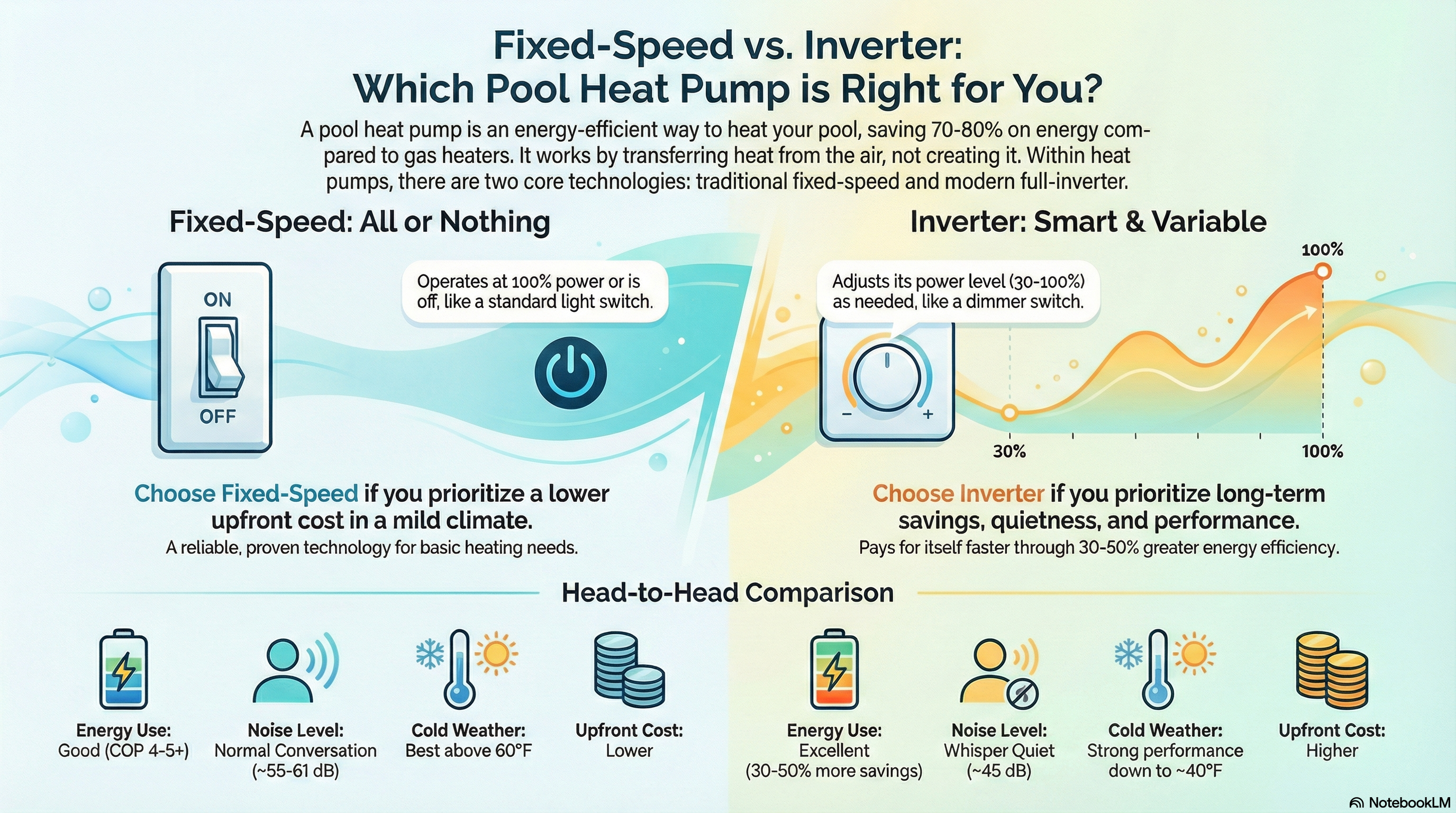
Now, within heat pumps, there are two tech types: fixed-speed (traditional, on/off like a light switch) and full-inverter (newer tech that is variable like a dimmer and adjusts power smoothly). Both types are great options, but inverters are better for savings and comfort. Let's explain so you can choose easily.
The Key Tech Difference
Fixed-Speed: Compressor runs at one full speed: on when needed, off when not. Quick to hit temp, but cycles a lot (full blast then stops).
Inverter: Compressor/fan speed varies (30-100%) based on demand. It ramps up or down gently, and runs longer at lower power.
Pros & Cons: Side-by-Side
| Aspect | Fixed-Speed (FH120/135/220/255/270) | Full-Inverter (FH235-i / FH285-i) |
|---|---|---|
| How It Feels | Fast full power bursts, but temp can fluctuate from cycles | Steady, even temp — no big swings |
| Energy Use | Good (COP 4–5+), but cycles waste some on startups | Excellent — 30-50% savings by avoiding spikes |
| Cold / Dry Weather | Best above 60°F humid; slows/stops lower | Stronger — consistent heat even ~40°F or dry air |
| Noise | Normal fan hum (~55-61 dB, like conversation) | Super quiet (~45 dB, whisper) |
| Startup | Quick full blast | Soft start — gentler on electrical |
| Features | Basic controls | App/Wi-Fi, schedules, auto modes |
| Upfront Cost | Lower | Higher, but pays back faster in energy |
| Lifespan / Wear | Reliable, but more cycles | Longer — less stress from smooth runs |
How They Feel in Real Use
Fixed-Speed: Like driving with a gas pedal that’s all or nothing. It gets you there, but with a noticeable stop/start feel.
Inverter: Like smart cruise control, smooth and efficient, it adjusts to the need and is a quieter ride.
Which Should You Choose?
Go Fixed-Speed if: Mild/warm climate, budget priority, simple needs—proven reliability (FH270 great for large steady pools).
Go Inverter if: Variable/colder/drier weather, max savings, quiet/remote control—future-proof (FH285-i tops big/variable setups).
Check Models & Specs for details or Sizing to match your pool.