How to Pick the Right Pool Pump: Sizing & Compatibility GuideUpdated 7 months ago
Sizing and installing a pool filter pump is typically handled by a professional pool builder or technician. They take into account your exact plumbing layout, elevation changes, and Total Dynamic Head (TDH) for a perfect fit.
This guide is here to give you the knowledge and tools to understand the process, calculate your pool’s needs, and have confident conversations with your pro. That way you can make sure you get the right pump — and avoid undersizing or overspending.
Your Pool Pump is the heart of your pool. A pool pump (also known as a 'filter pump' or 'circulating pump') moves the pool water through your entire system to keep it clean. It pushes water through the filter to catch dirt, mixes in chemicals to kill germs, and helps heat from your FibroPool heat pump spread evenly. Without a good pool pump, your pool can get dirty, grow algae, or even make people sick.
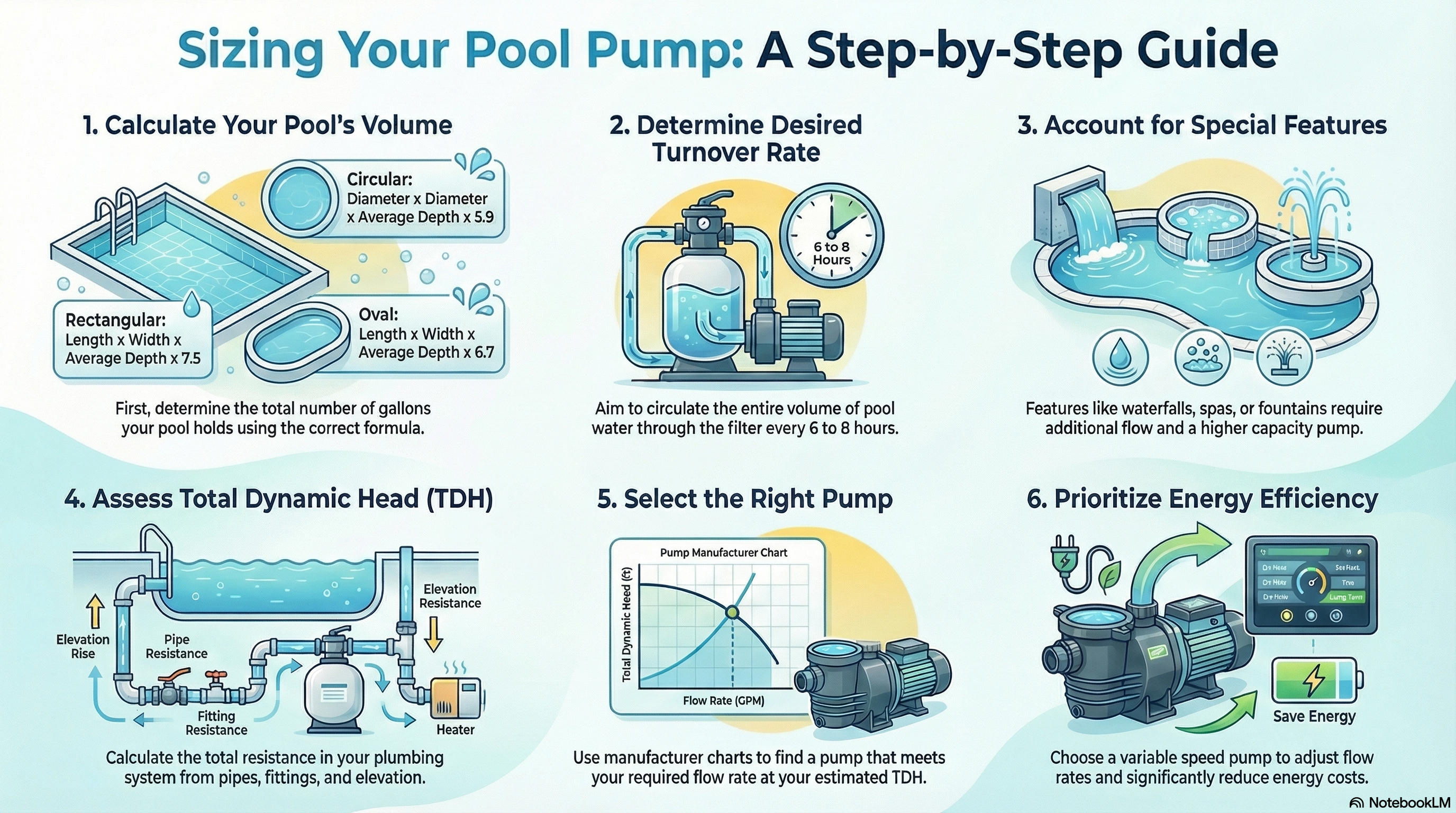
Picking the right size pool pump is all about turnover rate — how long it takes to filter the entire pool volume once.
The Core Equation
Here's the equation to find the minimum flow rate your pump needs (in gallons per minute, or GPM):
GPM = Pool Volume (gallons) ÷ (Desired Turnover Hours × 60)
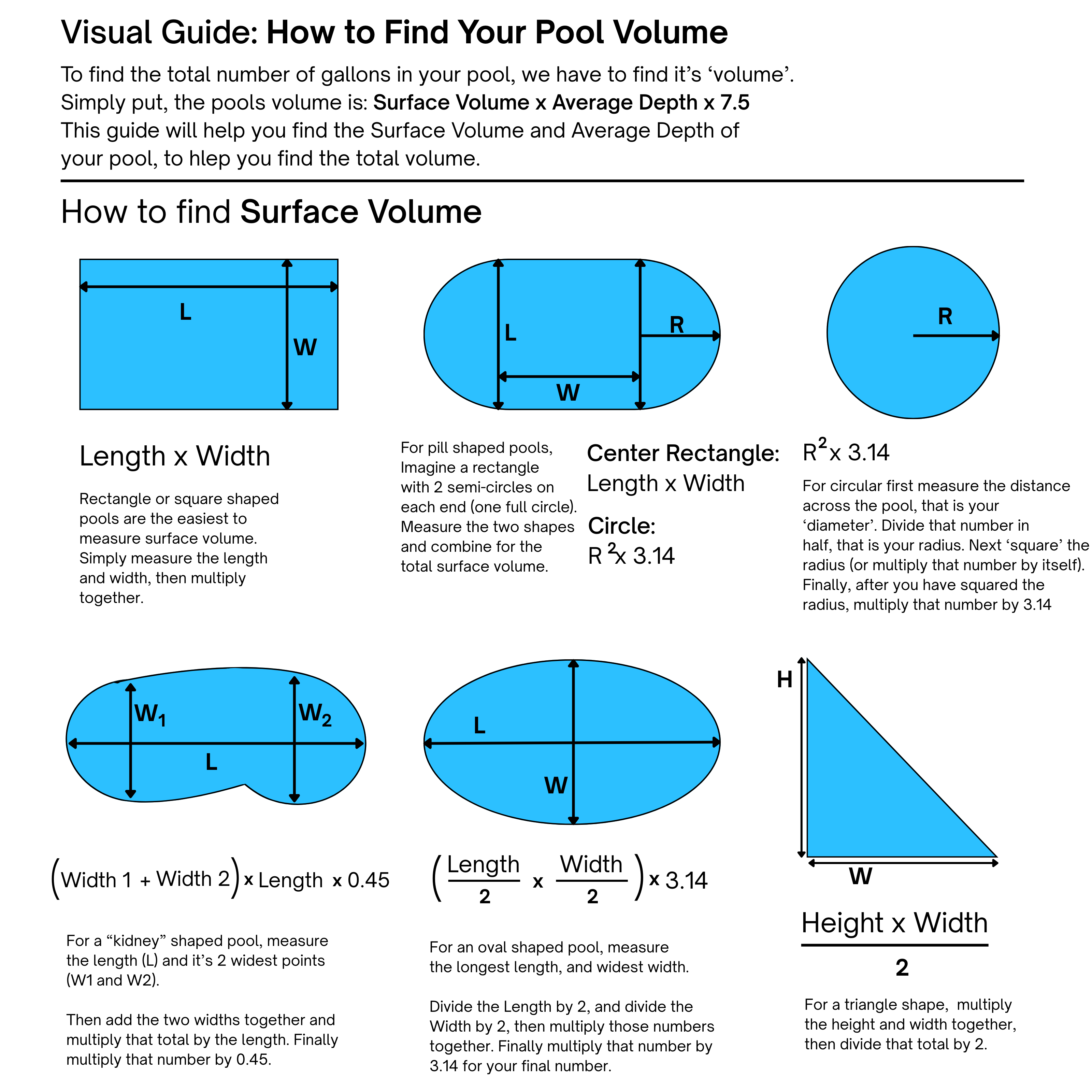
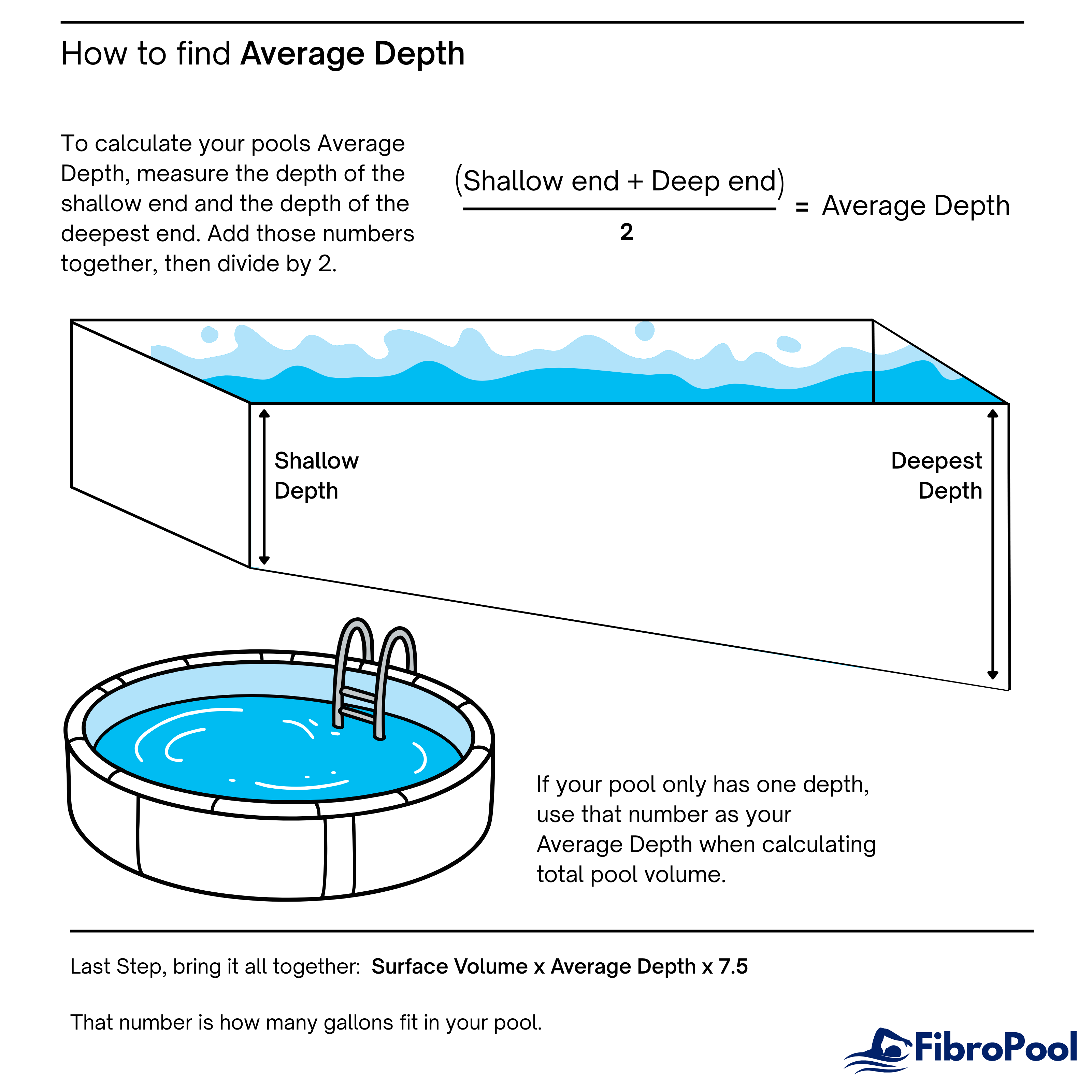
- Pool Volume = To find your pool volume, use the shape-specific formulas in our visual guide below.
- Desired Turnover = 6–8 hours for residential pools (6 is more aggressive/cleaner, 8 is standard and energy-friendly).
Quick Example
15,000-gallon pool aiming for an 8-hour turnover:
Required GPM = 15,000 ÷ (8 × 60) = 15,000 ÷ 480 ≈ 31.25 GPM
So choose a pump rated at least 32–35 GPM (after accounting for pipe resistance).
In this example you’d pick a pump rated at at least 32–35 GPM (after accounting for your plumbing resistance).
The Full Sizing Process
- Calculate your pool’s gallons (same steps we used in the heat pump guide).
- Pick your target turnover (6–8 hrs).
- Plug it into the equation above → get required GPM.
- Factor in Total Dynamic Head (TDH). This is the real-world resistance from pipes, elbows, height, etc. (usually 20–60 ft for most setups). Look at the pump’s performance curve to make sure it delivers your needed GPM at your estimated TDH.
Below is an example of the performance curve, these charts can be found in every Pool Pump manual, which is accessible on the product page.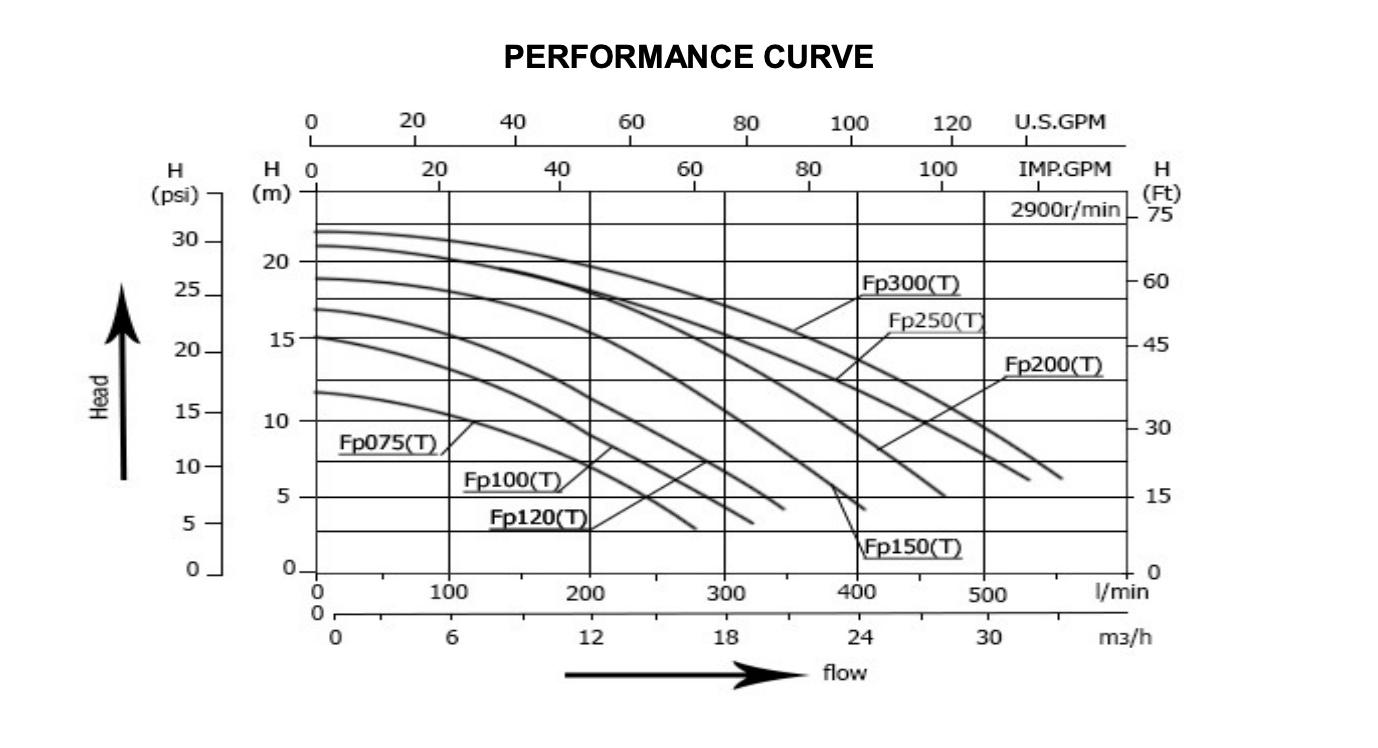
How to Read a Pump Performance Curve (like the one above)
This graph shows how much water each FibroPool pump can move (in Gallons Per Minute) at different levels of resistance in your plumbing system.
- Bottom axis = Flow Rate (GPM) — this is the number you calculated earlier using our formula.
- Left axis = Head (feet of pressure/resistance) — how hard the pump has to push against pipes, elbows, filters, and elevation.
Step-by-step: How to use this chart
- Calculate your required GPM using the formula on the previous page.
- Estimate your Total Dynamic Head (TDH) — most home pools fall between 25–45 feet. (If you have long pipes, lots of elbows, or a high filter, lean toward 40–45 ft.)
- Find your required GPM on the bottom axis and go straight up.
- Find your estimated head on the left axis and go straight across.
- The pump model whose curve is above that intersection point can deliver the flow you need.
Quick Example (15,000-gallon pool, 8-hour turnover = 31 GPM)If your TDH is about 35 feet:
- The Fp200(T) and Fp250(T) curves stay well above that point → they’ll easily give you 31+ GPM.
- The Fp150(T) curve drops below → it’s too small.
Recommended FibroPool Pump by Pool Size (8-hour turnover)
| Pool Size (gallons) | Recommended Single-Speed Pump | HP | Best For |
|---|---|---|---|
| Up to 6,000 | ABG050 or ABG075 | 0.5–0.75 | Small above-ground pools |
| 6,000 – 10,000 | Fp075(T) or ABG100 | 0.75–1 | Small in-ground or large above-ground |
| 10,000 – 15,000 | Fp100(T) or Fp120(T) | 1–1.25 | Most common residential pools |
| 15,000 – 20,000 | Fp150(T) | 1.5 | Medium in-ground pools |
| 20,000 – 25,000 | Fp200(T) | 2.0 | Larger in-ground pools |
| 25,000 – 30,000 | Fp250(T) | 2.5 | Very large pools |
| 30,000+ | Fp300(T) | 3.0 | Extra-large or commercial-style pools |
Pro Tip: For any pool size above, we strongly recommend stepping up to a FibroPool Variable-Speed pump (the VS series). They automatically adjust speed, cut energy use by 50–80%, run quieter, and you don’t have to guess your exact head pressure — they just work perfectly.